
Jump to section
- HKIS Math Philosophy
- Five Strands of Mathematical Proficiency
- Standards for Mathematical Practice
- Grade Overviews
- Grade 3
- Grade 4
- Grade 5
Our math program at the Upper Primary is focused on building procedural fluency through conceptual understanding and number sense. Students learn and use multiple models and strategies to show conceptual understanding and develop flexibility and fluency in all computational skills. The 8 mathematical practices are an integral part of our curriculum and instruction. Instruction follows the Common Core State Standards for Mathematics and uses Bridges in Mathematics as our primary resource for instructional content. Students have opportunities and support to engage in rich and challenging tasks that allow for productive struggle as they make sense of mathematical ideas and relationships. These tasks promote reasoning and problem-solving, meaningful mathematical discourse, and a positive mathematical mindset. Through the use of ongoing assessment, teachers implement various instructional strategies that meet students at their present level of learning and allow for depth, complexity, and extended learning. This practice affords students voice and choice in their learning, with self-evaluation and reflection naturally embedded.
HKIS Math Philosophy
We believe mathematics is a universal language that allows us to make sense of fundamental principles, ideas, patterns, problems and phenomena that surround us. Through exploring abstract and contextual mathematics, students will investigate applications and uses of mathematics in the world around them. Such investigations provide opportunities for students to engage in critical thinking and reasoning. Students will learn how to communicate and justify their thinking in multiple ways. Students will come to understand that mathematicians focus on big ideas in mathematics and the connections between ideas.
Students will be able to independently and collaboratively use their learning in mathematics to:
- Persevere and solve problems logically, creatively and confidently.
- Reason abstractly and quantitatively.
- Communicate thinking in a variety of situations and disciplines.
- Demonstrate the ability to process and plan by choosing efficient strategies and effective tools and resources.
- Apply learning in multiple ways and in familiar, unfamiliar and real-world contexts.
We agree that mathematics education happens best when we provide opportunities for students to:
- Take risks and make mistakes in an emotionally safe environment that values growth.
- Build a conceptually based foundation that moves between concrete, symbolic and abstract, in order to develop deep understanding.
- Reason and justify their thinking individually and with others.
- Think creatively and critically.
- Develop fact fluency through working with and exploring numbers in meaningful number activities.
- Ask questions, construct knowledge and reflect on the learning process.
Five Strands of Mathematical Proficiency
At HKIS, we develop students’ deep understanding of mathematics through meaningful exposure to and practice with the Five Strands of Mathematical Proficiency. These components work together and are interwoven and interdependent, forming the overarching framework for our daily mathematics instruction. The five strands describe what it truly means for a child to be successful in mathematics - ensuring that students not only learn mathematical skills, but also understand the ideas behind them, know how to approach and solve problems, explain their reasoning, and develop confidence and persistence as learners.
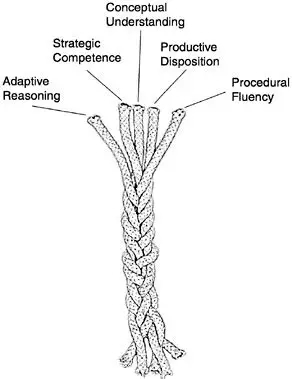
Conceptual Understanding: High achievers in mathematics understand the meaning of the operations and underlying math concepts of all areas of mathematics.
Productive Disposition: High achievers in mathematics are persistent.
Adaptive Reasoning: High achievers in mathematics can defend their thinking and critique the reasoning of others.
Strategic Competence: High achievers in mathematics are good problem posers and problem solvers.
Procedural Fluency: High achievers in mathematics can effectively, efficiently, and flexibly choose and use a variety of strategies to compute.
Standards for Mathematical Practice
The Standards for Mathematical Practice from the Common Core State Standards guide our teaching and learning in mathematics. While the Five Strands of Mathematical Proficiency describe what it means to be mathematically successful, the Mathematical Practices describe how students think and work to develop that proficiency. These practices reflect the habits and approaches of productive mathematical thinkers and are intentionally embedded in daily instruction. Through exploration and investigation, we support children in communicating their ideas, representing their thinking, and reflecting on their mathematical experiences.
Common Core State Standards for Mathematical Practice | Student Friendly Language |
|---|---|
Make sense of problems and persevere in solving them. | “I can make sense of problems and not give up.” |
Reason abstractly and quantitatively. | “I can think about and show numbers in different ways.” |
Construct viable arguments and critique the reasoning of others. | “I can explain my thinking and try to understand others.” |
Model with mathematics. | “I can model problems in many ways.” |
Use appropriate tools strategically. | “I can choose and use math tools. “ |
Attend to precision. | “I can work carefully and check my work.” |
Look for and make use of structure. | “I can find patterns and number relationships.“ |
Look for and express regularity in repeated reasoning. | “I can use patterns and take shortcuts.” |
Grade Overviews
Based on Common Core State Standards for Mathematics (CCSS-M) critical areas of focus and domains
Grade 3
Critical Areas of Focus:
- Developing understanding and strategies for multiplication and division within 100.
- Developing understanding of fractions, especially unit fractions.
- Developing understanding of the structure of rectangular arrays and of area.
- Describing and analyzing two-dimensional shapes.
Content Standards:
| Operations and Algebraic Thinking: | Number and Operations (Base Ten) | Number and Operations (Fractions) | Measurement and Data | Geometry |
|---|---|---|---|---|
Represent and solve problems involving multiplication and division. Understand the properties of multiplication and the relationship between multiplication and division. Multiply and divide within 100. Identify and explain patterns in arithmetic. | Use place value understanding and properties of operations to perform multi-digit arithmetic. | Develop an understanding of fractions as numbers. | Solve problems involving measurement, estimation of intervals of time, liquid volumes, and masses of objects. Represent and interpret data. Understand concepts of area and relate area to multiplication and addition. Recognize perimeter as an attribute of plane figures and distinguish between linear and area measures. | Reason with shapes and their attributes. |
Grade 4
Critical Areas of Focus:
- Developing understanding and fluency with multi-digit multiplication, and developing understanding of dividing to find quotients involving multi-digit dividends.
- Developing an understanding of fraction equivalence, addition and subtraction of fractions with like denominators, and multiplication of fractions by whole numbers.
- Understanding that geometric figures can be analyzed and classified based on their properties, such as having parallel sides, perpendicular sides, particular angle measures, and symmetry.
Content Standards:
| Operations and Algebraic Thinking: | Number and Operations (Base Ten) | Number and Operations (Fractions) | Measurement and Data | Geometry |
|---|---|---|---|---|
Use the four operations with whole numbers to solve problems. Gain familiarity with factors and multiples. Generate and analyze patterns. | Generalize place value understanding for multi-digit whole numbers. Use place value understanding and properties of operations to perform multi-digit arithmetic. | Extend understanding of fraction equivalence and ordering. Build fractions from unit fractions by extending understanding of operations on whole numbers. Understand decimal notation for fractions, and compare decimal fractions. | Solve problems involving measurement and conversion of measurements from a larger unit to a smaller unit. Represent and interpret data. Understand concepts of angle and measure angles. | Draw and identify lines and angles, and classify shapes by properties of their lines and angles. |
Grade 5
Critical Areas of Focus:
- Developing fluency with addition and subtraction of fractions, and developing an understanding of the multiplication of fractions and of division of fractions.
- Extending division to 2-digit divisors, integrating decimal fractions into the place value system and developing understanding of operations with decimals to hundredths, and developing fluency with whole number and decimal operations.
- Developing understanding of volume.
Content Standards:
| Operations and Algebraic Thinking: | Number and Operations (Base Ten) | Number and Operations (Fractions) | Measurement and Data | Geometry |
|---|---|---|---|---|
Write and interpret numerical expressions. Analyze patterns and relationships. | Understand the place value system. Perform operations with multi-digit whole numbers and with decimals to hundredths. | Use equivalent fractions as a strategy to add and subtract fractions. Apply and extend previous understandings of multiplication and division to multiply and divide fractions. | Solve problems involving measurement and conversion of measurements from a larger unit to a smaller unit. Represent and interpret data. Understand concepts of angle and measure angles. | Graph points on the coordinate plane to solve real-world and mathematical problems. Classify two-dimensional figures into categories based on their properties. |